Investing for Beginners Cheatsheet
🚀 Start Investing in 5 Minutes
Complete beginner? Here’s your path:
- Open a TFSA account (use referral links below)
- Buy a globally diversified ETF (like XEQT, VEQT, or a balanced option like XBAL if you prefer less volatility)
- Set up automatic investing from your paycheck
- That’s it – you’re now invested in the global economy
Want to know why this works? Keep reading below.
Why I use XEQT as the example throughout: I recommend the asset allocation ETFs from iShares (XEQT, XGRO, XBAL), Vanguard (VEQT, VGRO, VBAL), and BMO (ZEQT, ZGRO, ZBAL) pretty much equally. The differences between them are minimal. I use XEQT as my example simply because explaining concepts through one specific ticker is easier than overwhelming you with choices. Do not let picking between these become a reason to delay getting started.
📌 Quick Start Tip
Ready to jump in? I personally use both Questrade and Wealthsimple for my own investments. When you’re ready to open an account, check out my referral links to receive bonuses of $50 (Questrade) and up to $25 (Wealthsimple). Full disclosure: they’re referral links, so you get a bonus and I get one too.
Get Your Referral BonusesKey sections for different investors:
This guide summarizes advice from licensed financial advisors and academic research on effective investing, so you can build a strategy that fits your goals and risk tolerance, whether that’s a simple, diversified approach or something more active. For more comprehensive information, check out the resources at the end of this post. My YouTube channel demonstrates how to put these theories into practice.
Ready to dive in?
- Why should I invest and is investing risky?
- The growth of the global economy
- Navigating market volatility
- How market prices actually work
- Why it’s hard to beat the market
- Total return and compounding
- How much risk should I take?
- What do I need to get started?
- Which type of account should I open first?
- Simple Start: Your First Investment Action Plan
- Should I invest in stocks or ETFs?
- Which ETF should I start with?
- Why one all-in-one ETF is enough
- How to check if your portfolio is diversified
- When is the right time to buy?
- Should I lump sum or DCA?
- Limit order or market order?
- What about VFV, HMAX, HHIS and other trending ETFs?
- How should I analyze an ETF?
- How do people estimate expected returns?
- Should I invest in dividend or growth stocks?
- Should I avoid withholding tax? (VFV vs VOO)
- Is my portfolio diversified enough?
- I own multiple ETFs that overlap. Is this bad?
- I have XEQT. Should I add anything else?
- Why would a non-dividend stock’s price ever go up?
- Should I wait or keep investing regularly?
- Should I worry about the AI bubble or scary headlines?
- Should I check if the price is high or low before buying?
- Should I get into CAGE or factor investing?
Getting started: Understanding investing and opening your account
Why should I invest and is investing risky?
The growth of the global economy
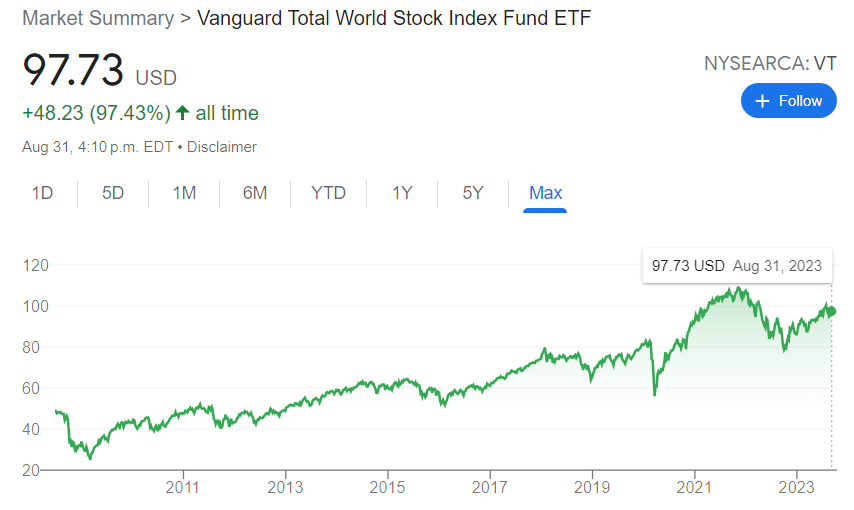
Navigating Market Volatility
“What if the stock market drops the day I buy? I’m going to regret it so bad!”
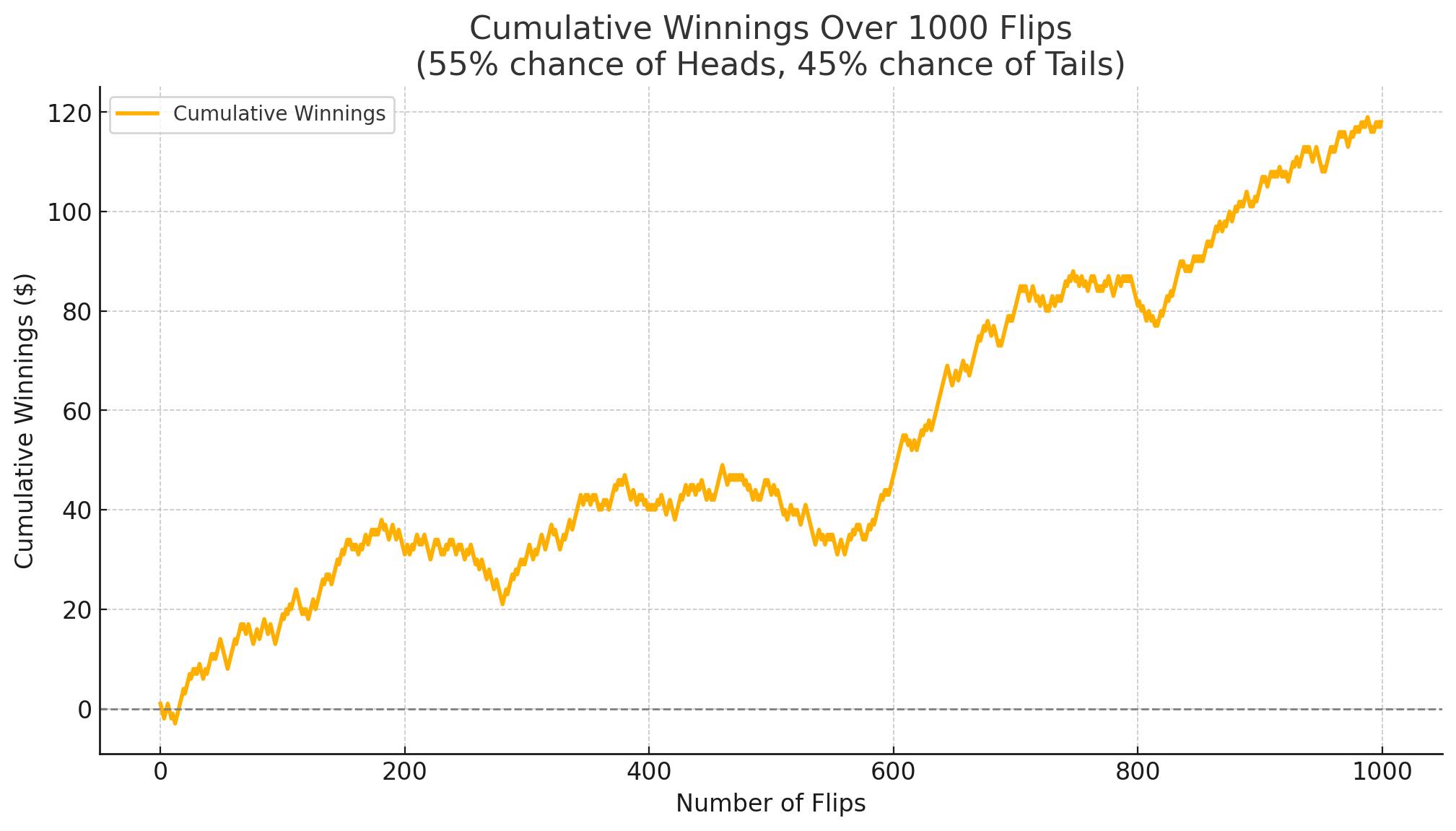
Show this run as a table
| Flip | Expected | Median | Best | Worst | Below expected |
|---|
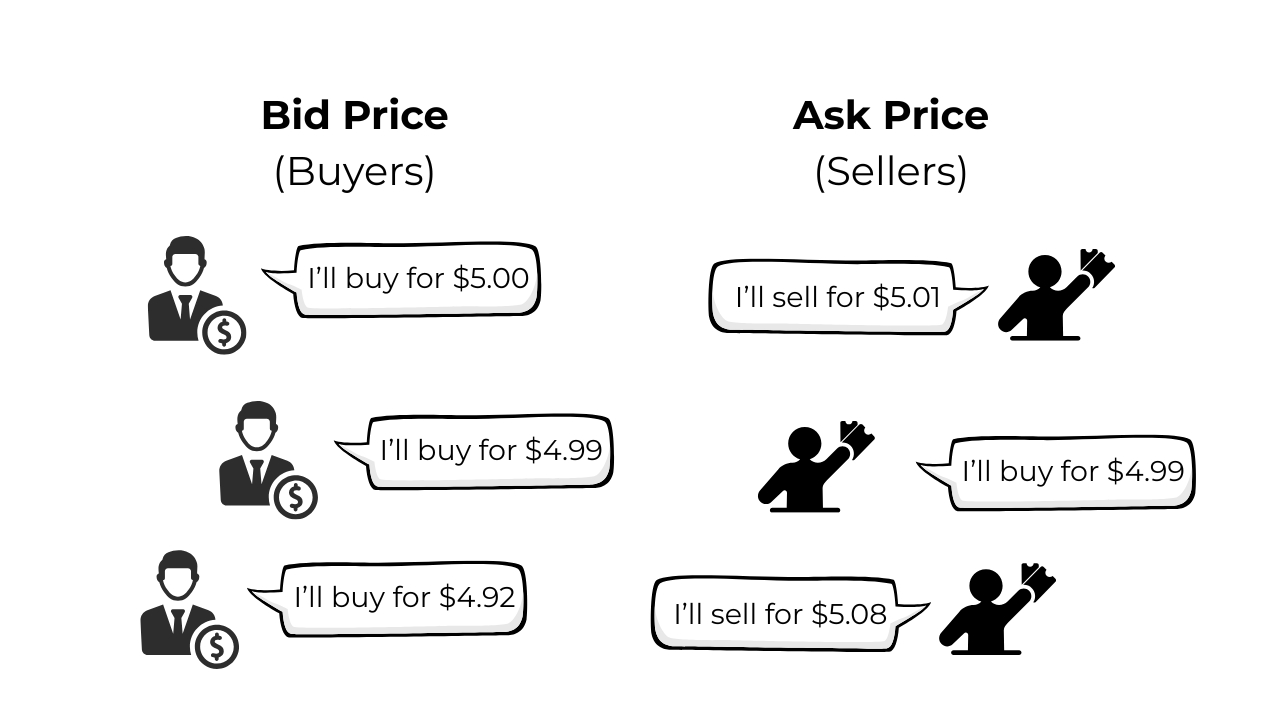
How market prices actually work
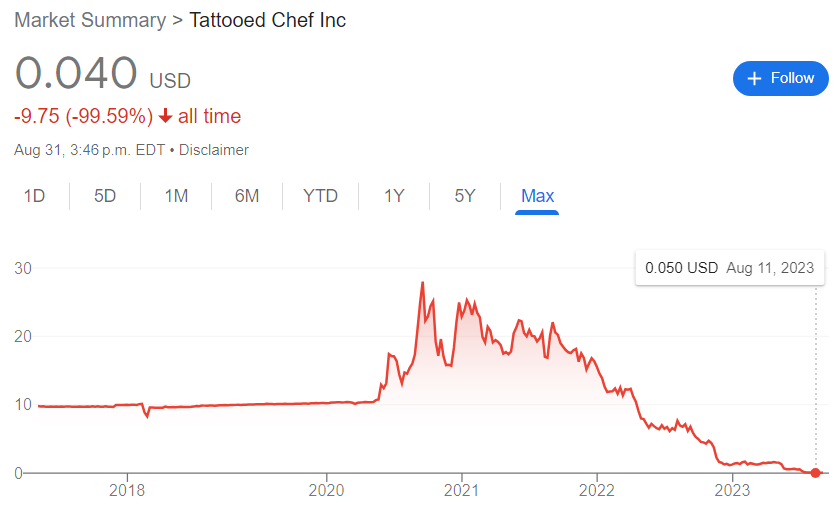
Why it’s hard to beat the market
💡 Key Insight
Stock picking is not about finding the best company. It is about finding a company that is better than what the market already expects. If everyone agrees Apple is a great company, that expectation is already reflected in the price.
🎯 From One of the Greats
Even the late Charlie Munger, considered one of the greatest active investors of all time, acknowledged how difficult stock picking really is: “You have got to somehow recognize a good business before it’s recognizable as a good business. That’s very hard to do. Some people get good at it, but not many.”
His solution? “It’s not difficult to just buy an index and sit on your ass. That’s the great default position.” Watch the clip
Total return and compounding
Most beginners hear “compounding” before they understand what’s actually compounding. The thing that compounds is your total return, which has two parts:
- Capital appreciation: the price of your shares going up over time
- Distributions: dividends, interest, or other payouts the investment makes
Both are forms of return. What compounds is the total, regardless of which form it arrives in. A pure-growth ETF and a high-dividend ETF that both deliver 8% per year compound at the same rate. The form your returns take doesn’t change the math.
This is why “growth stocks vs dividend stocks” is mostly a style preference, not a strategy difference. As long as you reinvest, what matters is the total return.
💡 Key Insight
What compounds is your total return, regardless of whether it arrives as price appreciation or as dividends. Reinvest consistently and give it time. The form doesn’t matter.
Compounding works because returns earn returns. A snowball rolling downhill picks up more snow with each rotation. The math is simple, but the consequences are dramatic over decades. The catch is that this only works in your favor when total returns are positive on average. With GICs and savings accounts, that’s guaranteed. With stocks and ETFs, it’s expected but not promised. The longer you stay invested in a diversified portfolio, the more time your expected returns have to compound and the more the volatility smooths out. This is where “time in the market beats timing the market” comes from.
What kind of returns to expect
Different asset classes carry different expected returns because they carry different risks. The market compensates risk with higher expected return:
- GICs (low risk, locked in): ~3-4% annually
- Bonds (moderate risk): historically 4-5%
- Global stocks (higher risk, more volatile): historically 6-8% over long periods
These aren’t promises. PWL Capital, for example, projects 100% global equities at about 6.87% annualized over the next 30 years, with a standard deviation of 12.57%, which means any given year could swing from roughly -18% to +32%. Vanguard’s projections sit in a similar range.
The takeaway: stocks earn more on average because investors get compensated for accepting more volatility along the way. Lock in a guarantee with GICs, you get less. Accept the swings with stocks, you get more, on average, over time.
For a deeper walkthrough of total return and where these expected return numbers come from, this video covers it:
For the math behind why share count doesn’t matter (and why reinvesting dividends doesn’t automatically build wealth), see the Share Count Guide.
How much risk should I take?
In the last section we saw that riskier asset classes carry higher expected returns. The natural next question is how much of that risk you should actually sign up for.
A common way beginners frame this is “growth vs. income”: young people should chase growth, retirees should chase income. But that framing points at the wrong thing. As we covered in Total return and compounding, what compounds is your total return regardless of the form it arrives in. The real question is simpler: what is the highest expected return I can get at a level of risk I can actually live with? Any combination of funds, growth, income, or both, should be judged on that, not on the label.
Risk isn’t one question. It’s three.
When advisors build a risk profile properly, they look at three separate things. This framing comes from Investment Risk Profiling: A Guide for Financial Advisors (Hubble, Grable & Dannhauser, CFA Institute, 2020), and it’s worth knowing all three exist even if you keep it simple:
- Risk need: how much return do you actually require to reach your goal? Someone who has already saved plenty may not need to take much risk at all. Someone starting late may need more growth than a savings account can provide. This is the dimension people skip most often.
- Risk-taking ability: how much risk can your situation absorb? A long time horizon, a stable income, and no near-term need for the money all raise it. Needing the cash in three years lowers it, no matter how brave you feel.
- Behavioural loss tolerance: how much risk can you actually live with? Can you watch your portfolio drop 30% and keep buying anyway? This one is about you, not your finances, and it’s the hardest to know in advance.
Your allocation has to respect all three. And when they disagree, for example when you need high returns but can’t stomach the swings, the answer usually isn’t forcing more risk. It’s saving more, adjusting the goal, or getting professional advice.
A rule of thumb that covers a lot of cases: pick the most aggressive allocation you’d still keep buying into during a crash. If you’re not sure, err one step more conservative. You can always dial up later once you’ve lived through a real dip.
Being able to afford risk is not a reason to take any risk
Here’s the part that trips up even confident beginners. “I’m young, I can afford more risk” gets used to justify concentrated bets: single stocks, one hot sector, leveraged funds. But the market only pays you a higher expected return for risk that can’t be diversified away, the risk of owning the whole market. Piling into one stock or one theme adds a lot of extra risk with no extra expected return to compensate you for it. Taking extra risk without a clear view of the expected return you’re getting for it isn’t aggressive investing. It’s gambling.
This is why “more risk” for a young investor should usually mean more equities in a diversified portfolio (XEQT instead of XBAL), not wilder bets.
Tools to find your starting point
You don’t have to figure this out by introspection alone. Two free questionnaires I’d point beginners to: PWL Capital’s Risk Profile tool (Canadian, built around the three dimensions above) and Vanguard’s Investor Questionnaire. Both suggest a stock/bond mix based on your answers. Treat the result as a starting point rather than a final answer. No form can simulate what losing real money feels like, so if you’ve never lived through a big drawdown, consider the suggestion a ceiling on your aggressiveness rather than a floor.
The all-in-one lineup is your risk dial
Whatever mix you land on, the practical tool for implementing it already exists: XEQT/VEQT (100% stocks), XGRO/VGRO (80/20), XBAL/VBAL (60/40), down to VCNS and VCIP. Same global diversification, different volatility. If a questionnaire suggests 80/20, that’s XGRO or VGRO. Choosing your risk level is as simple as choosing your position on that dial. As your situation changes, you move the dial, not the strategy.
💡 Key Insight
Your right level of risk is where three things meet: the return you need, the risk your situation can absorb, and the losses you can actually sit through. Take risk that pays (broad market exposure) and skip risk that doesn’t.
What do I need to get started?
Note: This link includes my referral ID automatically. If prompted during signup, use referral code: 615710143447880
Note: This link includes my referral code automatically. If prompted during signup, use referral code: ZJE11W
Which type of account should I open first?
Buying your first ETF
Simple Start: Your First Investment Action Plan
Which ETF should I start with?
📌 Don’t Overthink It
The difference between similar ETFs from different providers (like Vanguard’s VEQT vs iShares’ XEQT) is usually minimal. Choosing any of them and starting to invest earlier is often more beneficial than delaying while trying to pick the “perfect” fund.
Why one all-in-one ETF is enough (and usually best)
I get some version of this message every week: “I’m new, I hold XEQT plus one or two other funds, I keep changing things, and I just want to build a real portfolio.” Here’s the answer, stated as plainly as I can: if you own an all-in-one ETF, the portfolio is already built. XEQT holds roughly 9,700 companies across every developed and emerging market, weighted the way global investors collectively hold them, and it rebalances itself automatically. There is no missing piece for a second fund to fill.
Anything you add does one of three jobs, and none of them is “more diversification.” It duplicates what’s already inside (VFV holds the same US large caps XEQT already owns), it tilts your portfolio toward a slice of the market (a dividend fund like VDY concentrates you into a few dozen Canadian payers), or it changes your risk level, which is done more cleanly by switching to a different all-in-one. That’s the entire menu. The trending ETFs section and the overlap FAQ walk through why each of these needs a reason, and “it feels like I should own more things” is not one.
But the strongest argument has nothing to do with what’s inside the fund. It’s what one fund does to you. With a single holding there is nothing to fiddle with: no winner to chase, no loser to second-guess, no allocation to rebuild every time a new ticker trends. Every dollar you save has an obvious destination. The research on investor behaviour keeps finding that people lose more to their own adjustments than to almost anything else, and a one-fund portfolio starves the tinkering urge completely. Boring is not the compromise here. Boring is the feature.
There are legitimate reasons to eventually hold more than one fund: genuine conviction in something like a factor tilt, or specific goals with different time horizons. Those reasons arrive later, with research behind them, and they announce themselves. Until then, one all-in-one at your risk level plus a steady contribution is the strongest portfolio most investors will ever own.
💡 Key Insight
One all-in-one ETF is a complete portfolio. Adding to it doesn’t diversify it, it changes it, and every change needs a reason. Until you have one, the winning move is one fund, automatic contributions, and nothing to decide.
How to check if your portfolio is diversified
Step 1: Look at Geographic Allocation Most beginners focus on individual stock names but miss the bigger picture. While there are different ways to think about diversification, geographic allocation is one of the most effective and straightforward approaches.
For example, here’s how XEQT (a globally diversified All-in-One ETF) spreads investments across different countries:
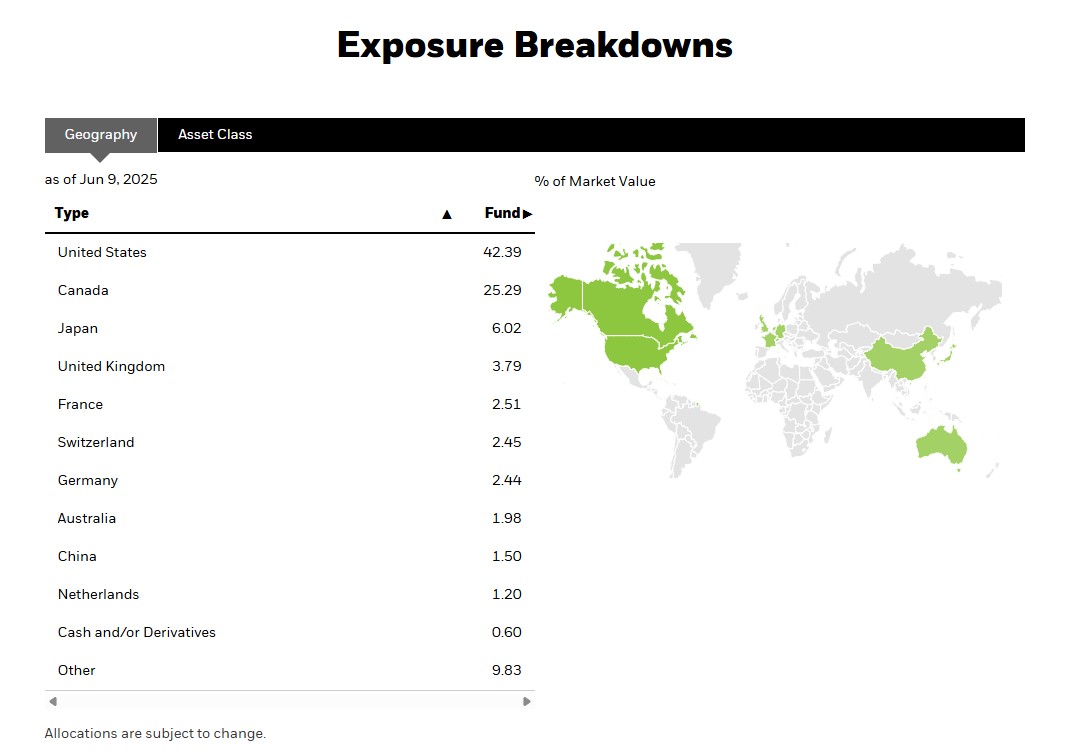
Notice the mix of US (42.39%), Canada (25.29%), and international markets? This global spread is what good diversification looks like.
Want to check your own ETFs? Here’s how to find this information yourself. Let’s use VEE (Vanguard’s Emerging Markets ETF) as an example. Visit the ETF’s webpage and scroll down to the “Market allocation” section:
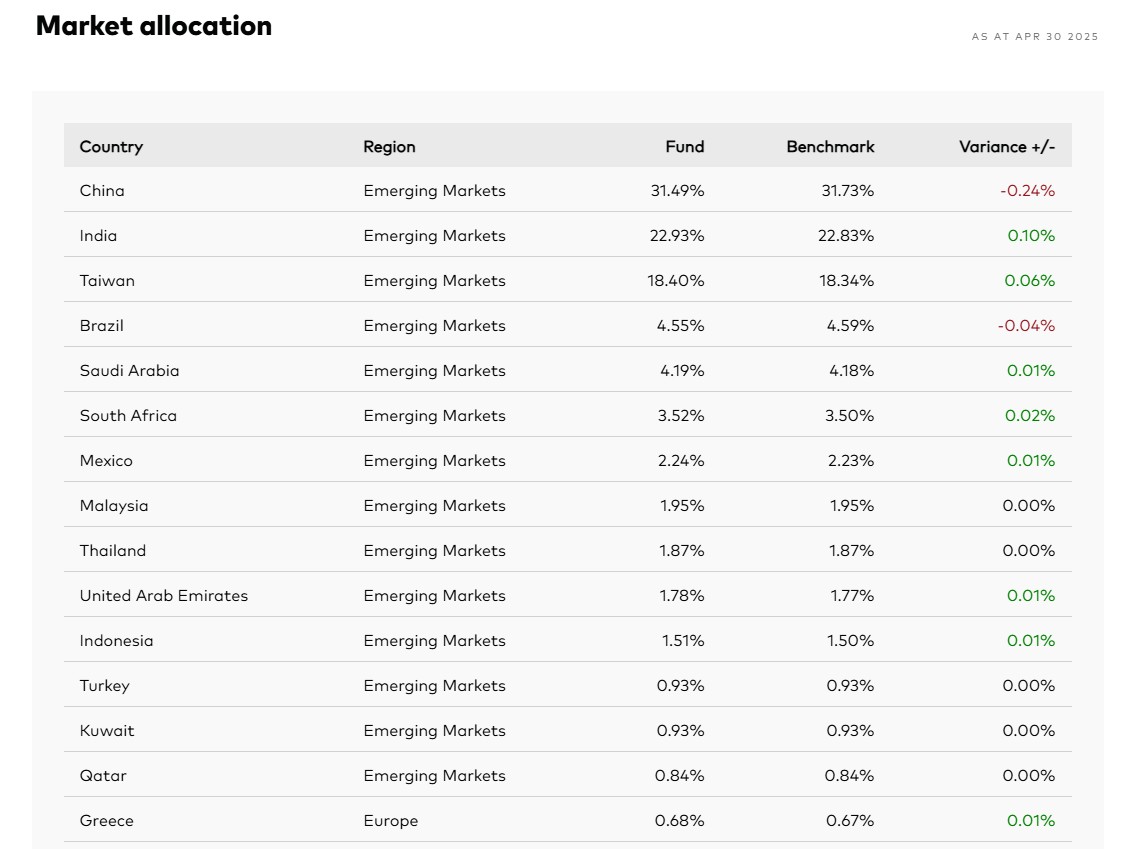
This shows exactly what you’re looking for – a table breaking down what percentage of the fund is invested in each country.
Step 2: Where to Find This Information For any ETF, look for:
- “Holdings” or “Portfolio” section on the fund company’s website
- Geographic breakdown or country allocation
- Sector allocation (Tech, Healthcare, Financials, etc.)
Step 3: A Sensible Baseline Licensed financial advisor Ben Felix suggests that something close to XEQT’s allocation is sensible: roughly 42% US, 25% Canada, and 33% international. He also thinks that roughly equal allocations (around 1/3 domestic, 1/3 US, 1/3 international) work well – the key is being reasonably close to this kind of global spread. Your exact percentages don’t need to match perfectly.
Why cap-weighting isn’t a “bias toward the US”
When someone says “XEQT is 42% US, that feels like too much,” they’re often picturing cap-weighting as if someone made a deliberate choice to overweight America. Nobody did. Cap-weighting just means each company is held in proportion to its actual size in the global market. The US makes up roughly 42% because, right now, US-listed companies represent roughly 42% of global investable equities. If that ratio shifts (and historically it has, a lot), the ETF rebalances automatically.
This is what people mean by the “market portfolio.” It is the neutral default. To deviate from it on purpose, you would need a reason to believe the market has the weights wrong, which loops back to why it’s hard to beat the market.
Things to Consider:
- More than 70% in any single country
- More than 40% in any single sector
- Owning multiple ETFs that overlap significantly
Remember: Perfect is the enemy of good. If you’re reasonably diversified, you’re likely fine.
When is the right time to buy?
“Time in the market is better than timing the market.”
“The best time to invest was yesterday, the next best time is now.”
What is lump sum and DCA (Dollar-Cost-Averaging)?
Should I lump sum or DCA?
A different way to think about it: it’s really an asset allocation question
Here’s a useful reframe from research by Brennan, Lee, and Torres (2005) and a follow-up paper from 2016: at every level of risk aversion they tested, DCA into 100% stocks is dominated by simply lump-summing into a more conservative mix and holding it.
The reason: DCA concentrates your equity exposure at the end of the deployment period. If you DCA over 12 months, you’re 100% in stocks during the final months but only 50% in stocks on average across the period. How the market performs in those final months ends up having an outsized influence on your total return. A static 50/50 split (lump-summed into half stocks, half cash, and held) gives you the same average exposure but spreads the risk evenly across all 12 months. Better time diversification.
The practical takeaway: if your reason for choosing DCA is “I’m uncomfortable being 100% in stocks right away,” the better answer might be “then don’t be 100% in stocks at all.” Pick an allocation that matches your risk tolerance (say, 60% XEQT + 40% in a high-interest savings ETF), lump sum into that, and let it ride. You get smoother volatility and you don’t have to think about deployment schedules.
This doesn’t change the answer for everyone. If you’re young, deploying long-term, and comfortable with 100% equities, lump sum into XEQT is still optimal on average. But if you were leaning DCA because you wanted less risk, asset allocation is the more direct lever to pull.
Limit order or market order?
Understanding bid and ask
What’s the difference?
What about really large orders?
Beyond your first ETF
What about VFV, HMAX, HHIS and other trending ETFs?
Before reaching for any of these, it helps to be clear on what adding one actually does. It does not simply expand your portfolio. It changes your allocation. Every dollar that goes into the new fund is a dollar of exposure you are choosing over your current holdings. So adding is really a trade, and the honest question is whether it is a trade you have a reason to make.
Whether that trade is an improvement depends on what you are trying to do. If you have chosen a broadly diversified, passive approach, an All-in-One ETF already gives you that. XEQT, for instance, spreads your money across roughly 9,700 companies worldwide. This is not the only valid portfolio. It is the broad, neutral starting point, and going passive is essentially the decision to hold that broad position rather than try to improve on it.
Seen this way, adding a fund is usually not filling a gap. It is placing a tilt. Take VFV. It holds around 500 large U.S. companies, and XEQT already holds those same companies inside its U.S. allocation. So buying VFV alongside XEQT does not broaden your portfolio. It concentrates it further into U.S. large-caps. There is nothing wrong with that, as long as you know that is the choice you are making. It only turns into a mistake when the tilt is accidental, when someone adds a fund expecting more diversification and quietly ends up with a more concentrated, more active bet instead.
And a tilt is a bet. You are wagering that the slice you lean into will do better than the broad market you started from, and as we covered in why it’s hard to beat the market, that is a hard thing to be right about. It is worth being honest about why a particular fund is tempting. Strong recent performance is the most common reason, though a high headline yield or a popular theme can pull just as hard. None of those tell you the tilt will pay off. A fund stands out today because something about it already happened, and that is history, not a forecast.
The reverse mistake is just as common. I have seen beginners hold over 20 ETFs, including an All-in-One, out of a fear of missing some important corner of the market. But the All-in-One already covers it. Most of those extra funds overlap with what is already there, so they add complexity without adding much real coverage.
None of this rules out other approaches. They can coexist, and your own strategy will sharpen as you gain experience. The point is narrower. A fund being popular or trending is not, on its own, a reason. Before adding anything, you should be able to say what it changes about your exposure, whether you actually want that change, and how confident you are that it will pay off.
In my video, Why I Don’t Have VFV | XEQT vs. VFV, I walk through one version of this question in detail: why I hold XEQT instead of VFV, even after VFV’s strong run in the U.S. market. It is a concrete look at choosing the broad position over a deliberate tilt.
How should I analyze an ETF?
How do people estimate expected returns?
Throughout this guide I’ve leaned on expected returns: stocks around 6-8% over long periods, bonds 4-5%, and so on. A fair question is where numbers like that come from, and whether you can calculate one yourself for a specific investment. The honest answer up front: there is no agreed-upon formula. Estimating expected returns is one of the genuinely unsolved problems in investing, and everyone picking investments is working from their own version of it. But it’s worth seeing how it’s done, because it explains which numbers you can lean on and which ones are guesses wearing a suit.
For the market as a whole
For broad, diversified portfolios, there are a few standard approaches, and they all point to roughly the same neighbourhood.
The first is history. We have over a century of data on global stock and bond returns, and the long-run averages are the starting point for most estimates. The obvious caveat is that the past isn’t a promise. But a hundred-plus years across dozens of countries, wars, and crashes is at least a meaningful sample.
The second is building the number up from parts. A stock’s long-run return has to come from somewhere: the cash the businesses pay out, plus the growth of their earnings, plus or minus any change in what investors will pay per dollar of earnings. So one common estimate is simply yield + growth. If a global portfolio yields around 2% and earnings grow around 4-5% per year, you land in that same 6-7% range. No crystal ball required. Bonds are even cleaner: a bond portfolio’s current yield to maturity is a decent estimate of its expected return, which is why bond projections are the least controversial part of any forecast.
The third is valuation. Some forecasters shade the estimate down when markets are expensive relative to earnings and up when they are cheap. This is why projections from PWL Capital, Vanguard, and others differ from each other and change over time: they weigh history, building blocks, and valuation differently. Notice, though, that they disagree about decimals, not direction. Nobody serious projects global stocks at 2% or at 15%.
For individual stocks: the DCF rabbit hole
For a single company, the textbook method is a discounted cash flow (DCF) valuation. The idea: a business is worth the cash it will generate for its owners over its lifetime, discounted back to today. Forecast the cash flows, pick a discount rate, and you get a “fair value”. Run it backwards from today’s price instead, and you get the stock’s implied expected return.
It’s a sound framework, and it’s how much of professional finance thinks. I’m describing it rather than recommending it, for two reasons. First, the output is extremely sensitive to the inputs: nudge the growth assumption by one percentage point and the “fair value” can swing 30% or more. Two careful analysts can run a DCF on the same company and get answers far enough apart to justify opposite trades. Second, and this is the deeper problem, a good DCF is not an edge. Every serious investor is running the same math, and the current price already reflects their collective forecasts. As we covered in Why it’s hard to beat the market, profiting from a DCF doesn’t require being right. It requires being more right than everyone else doing the exact same exercise, including full-time professionals with better data and faster tools than you. Some of them attempt exactly that for a living, and the evidence says most of them still don’t beat the market. It is not a beginner activity.
The takeaway
For a globally diversified portfolio, expected return estimates are imprecise but defensible. History, arithmetic, and valuation all point to the same range, and that range is what this guide’s advice is built on. For a single stock or a narrow theme, any precise-sounding expected return is somebody’s guess about the future. That asymmetry is the quiet reason diversification keeps winning in this guide: it’s the one strategy where the expected return doesn’t depend on you out-forecasting anyone.
💡 Key Insight
Expected returns for the broad market can be estimated within a defensible range. Expected returns for individual stocks are guesses dressed up in math. Build your plan on the number you can actually trust.
Should I invest in dividend or growth stocks?
You’ll often hear investors debate whether to focus on “dividend stocks” or “growth stocks,” but this framing is actually pretty misleading. It’s like asking whether you should buy “red cars” or “fast cars” – the color doesn’t tell you much about performance.
How “Growth” Gets Misapplied
When people say “dividend stock,” they’re usually talking about companies that choose to send cash directly to shareholders. But when they say “growth stock,” they often mean any company that doesn’t pay dividends – and that’s where things get confusing.
Just because a company doesn’t pay dividends doesn’t make it a growth stock. You might have a mature, profitable company with a reasonable P/E ratio that simply prefers share buybacks over dividends. Or you could have a value stock that’s temporarily cutting dividends due to market conditions. These aren’t “growth stocks” in the traditional sense – they don’t have the high P/E ratios, rapid revenue expansion, or reinvestment characteristics that actually define growth companies.
What Actually Matters
When you’re comparing, say, Enbridge to Nvidia, you’re really choosing between different industries, business models, and economic exposures. The dividend policy is just one small piece of a much bigger puzzle that includes the company’s fundamentals, sector dynamics, and expected total returns.
Frequently Asked Questions
Should I avoid withholding tax completely? I keep hearing about VFV and VOO.
I already started investing but I’m worried about my allocation. Is my portfolio diversified enough?
This is one of the most common questions from new investors. The good news? You don’t need the “perfect” portfolio to succeed.
Licensed financial advisor Ben Felix suggests a sensible baseline: roughly 1/3 domestic, 1/3 US, and 1/3 international stocks. But perfect is the enemy of good – we don’t know what the perfect portfolio is.
If your portfolio is reasonably close to this structure, or if you own an All-in-One ETF like XEQT, you’re most likely going to be fine. The difference between a “good” and “perfect” allocation is usually much smaller than the difference between investing and not investing at all.
Remember: as we discussed in Why It’s Hard to Beat the Market – even professionals struggle to optimize perfectly.
I own multiple ETFs that seem to overlap. Is this bad?
Not necessarily! Some overlap is normal and expected. The issue is when you own multiple funds that are essentially the same thing.
For example: VTI (US Total Market) and VOO (S&P 500) overlap significantly, but VTI is broader. That’s fine.
The problem: Owning both VFV and TDB902 (both track S&P 500) just creates extra complexity for no benefit.
Bottom line: A little overlap while building diversification is normal. Holding near-identical funds is just extra work.
I have XEQT. Should I add something else for income, growth, or diversification?
Almost always no. But this question keeps coming up, so let me explain why and how to think about it when it does.
It helps to be clear on what kind of question this is. Whether adding something to XEQT is “good” is not a fact anyone can hand you. Any ETF you add changes your allocation, and whether the new mix is better than what you had depends on what you are trying to do.
If you have decided to be a passive investor, you have already accepted the broad market as the neutral default. Under that approach, staying broad is not settling for less. It is the plan working as designed, and the burden is on any addition to justify why it belongs. Someone running an active strategy would weigh this differently, and that is a legitimate choice too. The point is that the answer depends on your own philosophy, not on whatever ticker is being suggested this week.
XEQT (or any of the all-in-ones) is already designed as a complete portfolio. It holds thousands of stocks across global markets, rebalances itself, and is built to be the only equity exposure most investors need. So why do beginners constantly want to add to it? Three patterns:
The income chase. “I want consistent income, so I’ll add some REITs or dividend stocks.” Selling 4% of your XEQT each year is economically identical to receiving a 4% dividend. Both reduce your remaining holdings by the same amount. Shifting toward dividend stocks usually means concentrating into fewer sectors (REITs, financials, utilities), which makes you less diversified than XEQT, not more. If you actually need to plan income from your portfolio, the retirement withdrawal calculator is the right tool, and it works on any diversified portfolio.
The growth chase. “XEQT is fine, but I want more upside, so I’ll add Nvidia or VFV.” This usually means concentrating into the US (which XEQT already holds at ~42%) or into specific tech names. To justify this, you’d need to believe these will outperform what the market already expects, and as we covered in why it’s hard to beat the market, that’s a hard game even for professionals.
False diversification. “I want more diversification, so I’ll add another ETF.” Most additions actually reduce diversification because they overlap with XEQT. Adding VFV means you’re now overweight US stocks. Adding XIC means you’re now overweight Canada. Diversification is about coverage, not about owning more tickers.
The common thread: any addition just changes your allocation. To know whether the new mix is better, you’d need a clear view of the added position’s expected return, its volatility, and how it correlates with XEQT. Most beginners can’t articulate any of those, which is why the answer is usually to leave it alone.
💡 The pattern to recognize
Adding things to XEQT doesn’t make your portfolio safer, more income-producing, or more diversified by default. It just changes your allocation. The better question is: do you actually expect the addition to outperform what’s already there, and how confident are you in that view?
For a more thorough walkthrough, this video is the long-form version:
If a stock doesn’t pay dividends, why would the share price ever go up?
This is one of the most common sticking points for beginners, and it makes total sense as a question. With a savings account or a GIC, you can see compounding happening: interest gets paid, the balance ticks up, more interest gets paid on the bigger balance. With a dividend stock, the same intuition works: dividends arrive as cash, you reinvest, you own more shares. But with a non-dividend stock, nothing visible is happening. The price just goes up. Where does that come from?
The answer: a stock is a claim on a company. When the company makes profits and chooses not to pay them out as dividends, those profits stay inside the business. The company reinvests them into new products, new markets, more equipment, more staff. Over time, that reinvestment grows the company’s future earnings. The market sees the company as more valuable than it was last year, and the share price rises to reflect that.
Two contrasting examples help. Berkshire Hathaway has paid no dividend in roughly 60 years, yet it has compounded shareholder wealth at an extraordinary rate. All of that growth shows up in the share price, because all of the profits have been reinvested inside the business. Coca-Cola pays a substantial dividend, because at its size and maturity it doesn’t have many high-return places to put new money to work. Returning the cash to shareholders lets them deploy it elsewhere. Different mechanisms, same underlying engine: the company creates value, and you participate in it as a shareholder.
This is also why “dividend stocks” and “non-dividend stocks” aren’t really different strategies. They’re different ways the same value gets returned to you. As we covered in Total return and compounding, what compounds for you as an investor is your total return, regardless of which form it arrives in. The “where does the growth come from?” question has a clean answer; you just don’t see it the way you see a dividend hitting your account.
Everyone is saying how the market is going to go down. Should I wait or keep investing regularly?
For most long-term investors, keep investing regularly. This is a common concern, especially when facing economic uncertainties like potential tariffs or inflation. But it’s important to remember the principles we discussed earlier about market efficiency and positive expected returns.
These concepts explain why consistently investing in a globally diversified portfolio is generally more effective than trying to time the market. As we explored in the Navigating Market Volatility section, short-term market movements are unpredictable, but the overall trajectory of the global economy tends to be upward over time.
Important qualifier: This advice assumes you’re investing money you won’t need in the short term (at least 5+ years away). If you’re investing for a short-term goal, facing financial instability, or can’t emotionally tolerate potential losses, you might need to adjust your strategy or consider more conservative investments.
💡 Key Insight
When people worry about market drops due to tariffs or other economic news, remember that stock prices are simply what buyers and sellers collectively agree on. These prices already incorporate all publicly available information including global concerns. Unless you have exclusive insights that millions of other investors don’t, your best approach is typically to keep following your investment plan.
History has repeatedly shown that investors who stay the course and continue regular investments through market uncertainty typically outperform those who try to time their entries and exits. Each time you invest, you’re buying at prices that reflect all current concerns about tariffs, inflation, or other economic factors.
Remember, this applies to broad market investments, not individual stocks. The principles discussed in the section above still hold true regardless of current headlines or market fears.
Should I worry about the AI bubble, Trump’s policies, or other scary headlines?
The short answer: the news you’re reacting to is also the news the market is reacting to.
Whether the worry is AI valuations getting stretched, tariffs and policy uncertainty under a Trump administration, or geopolitical instability in the Middle East, the answer comes back to the same place: how market prices actually work. The price of XEQT today already reflects what millions of investors collectively think those risks are worth. If “AI is in a bubble” is something you’ve concluded from reading headlines, professional investors managing trillions of dollars have read the same headlines and adjusted their positions long before you or I had a chance to.
This does not mean the market is always right. It means that to act on your worry, you would need to believe you know something the rest of the market does not. As we covered in why it’s hard to beat the market, that is incredibly difficult to do consistently, even for full-time professionals.
What this looks like applied to specific worries:
- AI bubble or stretched valuations: Maybe. But if it is obvious enough for you to see, it is already in the price. There is also another side of the trade, professional investors who looked at the same data and decided current valuations are reasonable. You are not the only one who has noticed.
- Trump tariffs and policy uncertainty: Same logic. Every major bank and analyst has been modelling tariff scenarios for months. Whatever you read in the news this week, they read it weeks or months ago and prices reflect their collective best guess.
- Conflict in the Middle East or geopolitical instability: Conflict and uncertainty are not new. The market has priced through the Cold War, multiple oil shocks, 9/11, the wars in Iraq and Afghanistan, and Russia’s invasion of Ukraine. Markets tend to absorb difficult news faster than headlines suggest.
- Too much US in XEQT: See how to check if your portfolio is diversified. The short version is that cap-weighting reflects the actual size of those companies in the global economy, not a bias toward them.
💡 The pattern to recognize
The trap is treating each new headline as a unique reason to deviate from your plan. There is always a reason. AI today, tariffs tomorrow, something else next year. The reason your plan works is that it does not depend on you correctly predicting which headlines matter.
An honest qualifier: this assumes you are investing money you do not need in the short term and that your overall allocation still matches your risk tolerance. If today’s news is making you genuinely anxious about your portfolio, the issue is more often that your allocation is too aggressive for you, not that the news is uniquely bad. The fix in that case is moving toward something like XBAL or VBAL, not jumping to a different theme or sitting on cash.
Should I check if the price is higher or lower than average before buying?
No. When you’re investing in a diversified ETF on a regular schedule, checking price charts or comparing to historical averages is just another form of market timing – and it’s not a useful one.
Here’s why: As we discussed in How Market Prices Actually Work, the current price already reflects what millions of investors collectively think the asset is worth right now. That price incorporates all publicly available information, including whether it’s “high” or “low” compared to historical levels.
The problem with waiting for “lower” prices:
If you’re planning to invest monthly in XEQT or VFV, checking whether today’s price is above or below some average assumes you know something the market doesn’t. But as we covered in Why It’s Hard to Beat the Market, that’s incredibly difficult even for professionals.
More importantly, this approach costs you time in the market. Remember the rigged coin analogy? Every day you delay investing because you’re waiting for a “better” price is like refusing to flip the coin that’s weighted in your favor.
What about when prices hit all-time highs?
This particularly confuses beginners – shouldn’t you wait if prices are at record levels? But think about it: in a growing economy, hitting new highs is literally what we expect to happen over time. The market hits all-time highs regularly, and investors who waited for a pullback often missed out on further gains.
The right approach:
For regular monthly investing in diversified ETFs:
- Set your investment amount
- Invest on a consistent schedule (same day each month works well)
- Don’t look at whether it’s “high” or “low”
- Just keep going
This aligns with what we discussed in Lump Sum vs DCA – the research shows that consistent investing without trying to time entry points typically produces better results than attempting to optimize purchase timing.
Exception: If you’re making a large one-time investment (like an inheritance), the lump sum vs DCA decision is worth considering. But even then, the question isn’t “is the market high?” – it’s about your risk tolerance and time horizon.
Should I switch to CAGE or get into factor investing?
Probably not as your starting point. But it’s worth understanding what the conversation is about, because you’ll see CAGE come up a lot in Canadian investing communities.
What factors are, briefly: Academic research (most famously the Fama-French models) has identified company characteristics that have historically been associated with higher long-term returns. Things like value (cheap stocks vs expensive), size (small companies vs large), and profitability. A “factor ETF” tilts its weights toward stocks that score well on these characteristics, instead of just holding companies in proportion to their market size like XEQT does.
What CAGE is: Avantis Canadian Equity ETF (CAGE) is a globally diversified all-in-one similar to XEQT in scope, but with tilts toward value and profitability factors. It still holds thousands of stocks across global markets, so it’s not a concentrated bet, but it weighs companies a bit differently than a pure cap-weighted approach. Performance over a typical year is usually within a few percent of XEQT in either direction.
Whether to use it: The best answer I’ve heard to “who is factor investing for?” comes from Ben Felix in a Bogleheads interview, and the rest of this answer is my summary of his argument. His starting point: the risk isn’t what people assume. A moderately tilted fund like CAGE still looks mostly like the market, so a 30% market drop won’t turn into a 50% loss for you. The real risk is behavioural. Historically, factor premiums have taken decades to show up, and a tilted fund can trail a plain index like XEQT for 10 or 15 years without anything being wrong. If you start without real conviction, some year in that stretch will shake you out, and you’ll have paid all the underperformance while collecting none of the payoff. Or in his words: “You have to stay in your seat, or you’re going to miss the game when the action finally shows up.”
He also makes a point about conviction that I rarely see anywhere else: it has a price. The only way to build it is to study the research until you actually believe it, and all those hours are a real cost that can quietly cancel out the extra return the tilt was supposed to deliver. The exception is if you’d happily do that reading anyway, in which case it stops being a cost at all.
His last point cuts in factor investing’s favour, and it stuck with me. Everything above applies to plain equities too. The broad market has had its own long deserts, like 1968 to 1984 and the 2000s “lost decade,” where stocks barely beat inflation. We just haven’t lived through one recently, so nobody prices in that possibility. And historically, those weak broad-market stretches are exactly when factor tilts earned their keep.
For most beginners, the cap-weighted all-in-ones (XEQT, VEQT, ZEQT) remain the cleaner starting point. They’re the neutral default that requires no view about factors continuing to work. If you become genuinely interested in factor investing later, that’s the right time to evaluate something like CAGE. Going there first because of online hype is the same trap as picking individual stocks based on what’s trending.
Update (July 2026): I wrote a full deep dive answering every CAGE question I keep getting, including the MER, overlap with XEQT, the CASV alternative, and how I built my own conviction: CAGE Explained.
Other Resources
What are resources that you recommend?
Risk profile questionnaires: